Strategies to Avoid 90% AI-Induced Layoffs by 2027
Did you know 90% of independent freelancers could lose gigs to AI by 2027? That’s not a scare tactic—it’s a wake-up call. A recent Brookings study found a 2% drop in contracts and a 5% earnings decline for AI-exposed freelancers. Hourly rates are being undercut, framework adoption is skyrocketing, and maintenance overruns are eating budgets alive.
In this article, you’ll discover step-by-step solutions, from leveraging top AI upskilling hubs like 11 Must-Try AI Tools to cutting hidden costs in automated workflows. We’ll unpack six actionable sections that cover everything from building AI-proof skillsets to negotiating premium rates.
Feeling the pressure? You’re not alone, and help is here. Keep reading to transform uncertainty into opportunity—and secure your freelance future today.
Turn AI Market Data into Your Freelance Roadmap

Raw hourly rates and adoption benchmarks are more than just numbers—they’re the foundation for repricing your services and carving out high-value niches. In this section, you’ll translate market data into a clear, step-by-step freelance roadmap that protects you from the coming AI-driven pricing squeeze.
By overlaying regional rate bands, framework penetration figures, skill-premiums and total-cost-of-ownership trends, you’ll draft proposals that capture premium fees and justify multi-year retainers.
Audit Your Rate Positioning
Start by mapping your current hourly rate against North America’s $60–150/hr band and South Asia’s $20–45/hr. This quick audit reveals whether you’re competing on price, specialization or value.
Factor in Framework Demand
Align your niche with the platforms that draw budgets. According to recent surveys, 65% of AI teams use TensorFlow and 60% use PyTorch, while Hugging Face exceeds 1 million downloads per month.
- If you’re at entry level ($25–50/hr), focus on modular PyTorch scripts or Hugging Face pipelines.
- Mid-level specialists ($50–100/hr) can bundle TensorFlow model tuning with deployment support.
- Senior devs ($100–200+/hr) pitch full MLOps stacks using the latest TF 3.0 features or HF Custom Inference.
Embed Fees and Premiums
Every proposal should layer on surcharges and buffers to protect margins:
- Skill-Premium Surcharge: Add 10–35% for CV, NLP or MLOps expertise.
- Annual Maintenance Fee: Charge 20–30% of project value for updates, monitoring and bug fixes.
- Contingency Buffer: Include a 15% reserve for scope creep or unplanned iterations.
Leverage TCO Insights
Use a three-year total cost of ownership model with an assumed 120% year-over-year cost creep. Benchmarks show healthcare has 40% MLOps penetration versus finance’s 55%. Adjust your pitch to emphasize efficiency gains:
- Show that a 55% penetration in finance yields 2× ROI on automated pipelines.
- For healthcare clients, illustrate how a maintenance retainer mitigates 120% annual cost spikes.
- Offer long-term retainers at a 10–15% discount off the three-year TCO to lock in stable revenue.
Pivot to AI-Resistant Skills with Concrete Learning Paths

As AI continues to automate routine work, developers and data professionals must target skills that remain in high demand. By following structured, budget-friendly programs, you can secure AI-resistant expertise and command premium rates before mass layoffs hit.
Below are six focused learning paths—complete with pricing, timelines and weekly scheduling advice—to guide your upskilling over the next three to six months. Sign up, set calendar reminders and track progress to stay on pace.
1. Coursera TensorFlow Developer Certificate
Sign up for the DeepLearning.AI TensorFlow Developer Professional Certificate on Coursera at USD 49/month. Plan a 3-month schedule:
- Week 1–4: Complete “Introduction to TensorFlow” modules (15 hrs)
- Week 5–8: Build and train CNNs, RNNs (20 hrs)
- Week 9–12: Final exam prep and mock projects (20 hrs)
Google’s 2024 update added TF 2.12 support and end-to-end labs. Allocate 2 evenings a week and one weekend day for hands-on exercises.
2. Hugging Face NLP Fine-tuning Workshops
Create a free Hugging Face account and enroll in the series of live “NLP Fine-tuning Workshops.” Each 2-hour session runs weekly over 4 weeks:
- Week 1: Adapter-based fine-tuning with LoRA
- Week 2: Supervised Fine-Tuning on custom data
- Week 3: Quantization and deployment on HF Hub
- Week 4: Scaling to multi-GPU and LoRA plugins
The Hugging Face Hub reports over 1 million monthly downloads of transformers; this hands-on series leverages the latest 2025 release of the Accelerate library.
3. AWS SageMaker MLOps Expertise
Launch an AWS Free Tier account and enable SageMaker. Focus on ml.m5.large instances, priced at USD 0.10/hr for training and USD 0.05/hr for endpoint inference. New serverless inference tiers now start at USD 0.045/hr for micro-bursts.
- Week 1–2: Studio Notebooks and built-in algos (10 hrs)
- Week 3–6: Build CI/CD pipelines using SageMaker Pipelines (20 hrs)
- Week 7–8: Deploy endpoints and monitor drift (10 hrs)
Budget roughly USD 100 for 1,000 training hours and USD 50 for 1,000 inference hours to prototype end-to-end MLOps workflows.
4. Labelbox Data Labeling Project
Sign up for Labelbox’s self-serve plan at USD 0.08/image. Plan a 50,000-image dataset and allocate USD 4,000. Follow this schedule over two weeks:
- Day 1–2: Tool setup and schema design
- Day 3–8: Label teams label 6,250 images/day
- Day 9–10: Quality review and relabeling
This hands-on labeling project prepares you for data-centric AI roles and builds a portfolio dataset suitable for Kaggle or portfolio demos.
5. Google Cloud Professional ML Engineer
Register for the GCP ML Engineer exam ($200 fee). Build a 30-day study plan:
- Week 1: Vertex AI fundamentals (10 hrs)
- Week 2: Data pipelines with Dataflow and BigQuery ML (12 hrs)
- Week 3: Model tuning and deployment (8 hrs)
- Week 4: Practice exams and case studies (10 hrs)
Schedule daily 1-hour review sessions and lock in your exam date on the Google Certification Portal by day 15.
6. PyTorch Lightning Bootcamp on Udemy
Purchase the one-time USD 19.99 course “PyTorch Lightning Bootcamp” and join the 6-week cohort Slack community. Suggested pacing:
- Week 1–2: Lightning basics, data modules (8 hrs)
- Week 3–4: Custom callbacks and loggers (10 hrs)
- Week 5: Distributed training and TPU integration (6 hrs)
- Week 6: Capstone project and peer review (6 hrs)
Block out two weeknight evenings for video lectures and one weekend morning for coding challenges.
Set Up an End-to-End AI Freelance Service Stack
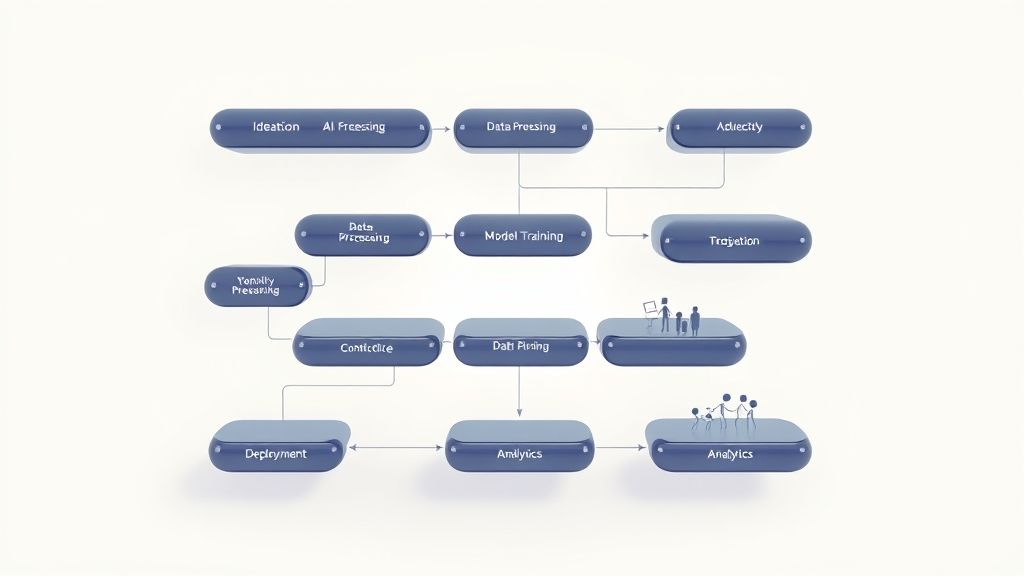
Building a turnkey AI service stack lets you deliver models faster and more reliably, from cloud setup through deployment and monitoring. By combining AWS EC2 G4 instances, TensorFlow/PyTorch, Hugging Face endpoints, Docker, Jenkins, Prometheus/Grafana, and Kubeflow Pipelines, you’ll handle inference, CI/CD, and automated retraining in one streamlined flow.
This guide walks through a hands-on environment setup, framework installation, deployment, orchestration, metrics collection, and pipeline automation—complete with command-line snippets and config references.
Environment Setup
Launch an AWS EC2 G4dn.xlarge (NVIDIA T4 GPU) with Ubuntu 20.04. The on-demand rate is $0.526/hr in us-east-1; recent AWS cuts in 2025 can drop it to ~$0.29/hr. Ubuntu 20.04 LTS supports Python 3.9 out of the box.
aws ec2 run-instances \
  --instance-type g4dn.xlarge \
  --image-id ami-0abcdef1234567890 \
  --key-name my-key \
  --security-groups sg-0123456789abcdef0 \
  --tag-specifications 'ResourceType=instance,Tags=[{Key=Name,Value=ai-stack}]'
Framework Installation & GPU Verification
SSH in and install CUDA 11.2, then Python 3.9, TensorFlow 2.9 and PyTorch 1.12 in a virtualenv.
sudo apt-get update && sudo apt-get install -y build-essential \
  cuda-toolkit-11-2 python3.9 python3.9-venv
python3.9 -m venv venv && source venv/bin/activate
pip install --upgrade pip
pip install tensorflow==2.9 torch==1.12 torchvision
Verify GPU visibility:
nvidia-smi
# Should list Turing T4 with driver ≥460.xx and CUDA 11.2 support
Deploying on Hugging Face Inference API
Use the free tier (30 K requests/mo) for prototyping or upgrade to Pro ($9/mo for 100 K requests) when scaling. Below is a cost comparison.
curl -X POST https://api-inference.huggingface.co/models/username/model \
  -H "Authorization: Bearer $HF_TOKEN" \
  -d '{"inputs":"Your text here"}'
Containerization & CI/CD with Docker and Jenkins
Package your Python code into Docker 20.10. Create a simple Dockerfile that installs CUDA 11.2 and your venv.
FROM nvidia/cuda:11.2-runtime-ubuntu20.04
WORKDIR /app
COPY venv venv
COPY src/ src/
ENTRYPOINT ["venv/bin/python", "src/server.py"]
Use Jenkins 2.319 to build and push images on each commit. Example Jenkinsfile:
pipeline {
  agent any
  stages {
    stage('Build') { steps { sh 'docker build -t myrepo/ai-service:$BUILD_ID .' } }
    stage('Push')  { steps { withCredentials(...) { sh 'docker push myrepo/ai-service:$BUILD_ID' } } }
  }
}
Monitoring with Prometheus & Grafana
Deploy Prometheus 2.33 to scrape your container’s /metrics endpoint, and Grafana 9.1 for visualization. Both are open source with no license fee.
# prometheus.yml snippet
scrape_configs:
  - job_name: 'ai_service'
    static_configs:
      - targets: ['localhost:8000']
Point Grafana at Prometheus and import dashboard JSON for real-time GPU utilization and latency charts.
Automating Retraining with Kubeflow Pipelines
Kubeflow Pipelines automates your end-to-end retraining workflow. As of Q1 2024, ~55% of finance teams and ~40% of healthcare groups run Kubeflow in production.
import kfp
@kfp.dsl.pipeline(name='retrain-pipeline')
def retrain():
    preprocess = ...
    train = ...
    deploy = ...
kfp.Client().create_run_from_pipeline_func(retrain, arguments={})
Schedule this pipeline daily or on data drift triggers to keep models fresh without manual intervention.
Frequently Asked Questions About AI Impact on Freelancing

As AI accelerates, freelancers face new challenges—and opportunities. Below, we address the most pressing questions on preserving your income, setting rates and tooling up for a resilient AI-driven market.
Each answer combines industry benchmarks, current research and actionable tips to help you navigate the shift.
Which freelance skills will survive AI automation by 2027?
Skills in Natural Language Processing (NLP), MLOps and computer vision remain in high demand. LinkedIn reports a 37.3% CAGR for AI roles through 2025, with machine learning engineers and NLP specialists leading growth. Expect to add a 10–35% skill surcharge when bidding on NLP or CV projects—reflecting premium rates for expertise in TensorFlow, PyTorch, Kubeflow and cloud-based MLOps pipelines.
How much should I charge for AI projects right now?
Current market rates vary by experience:
- Entry: $25–50/hr
- Mid: $50–100/hr
- Senior: $100–200+/hr
Factor in a 10–35% surcharge for specialized NLP or computer vision work, and benchmark against Upwork’s latest data showing a 15% year-over-year rise in AI-related hourly rates.
What core tools do I need for a complete AI service offering?
A robust AI stack typically includes:
- Modeling: TensorFlow, PyTorch
- MLOps: Kubeflow, MLflow, Apache Airflow
- Cloud: AWS SageMaker, GCP AI Platform or Azure ML
- Data labeling: Label Studio or Scale AI
- Monitoring: Prometheus, Grafana, Seldon Core
These platforms integrate end-to-end—from data ingestion to deployment—mirroring best practices in high-growth markets noted by Public Insight and ML-Jobs.ai.
How do I factor in maintenance and retraining costs?
Plan for annual maintenance of 20–30% of your initial project fee, plus a 15% contingency buffer. For instance, a $100K deployment would carry $20–30K in upkeep and another $15K reserved for unexpected retraining—aligning with industry norms cited by PeopleInAI and enterprise ML benchmarks.
What ROI benchmarks can I cite to win clients?
Showcasing these metrics helps prospects visualize tangible gains, underpinned by case studies in generative AI and real-time analytics.
How do I handle data-labeling overhead efficiently?
Streamline labeling by:
- Leveraging pre-label tooling (e.g., AWS Ground Truth auto-labeling)
- Batching tasks with semi-automated scripts in Python
- Outsourcing to specialized platforms like Scale AI or Hive
- Incorporating active learning to reduce manual examples over time
These tactics can cut labeling costs by up to 40%—a key factor for scalable AI projects.
Build Client Proposals with 3-Year TCO and ROI Models
When pitching AI-driven solutions, clients expect clear visibility into multi-year budgets and returns. A 3-year Total Cost of Ownership (TCO) framework paired with a robust ROI model elevates your proposal from a rough estimate to a strategic plan. Embedding line-item detail—ranging from headcount to cloud infrastructure—demonstrates rigor and builds trust.
Below is a ready-to-use structure: first outline salary vs. freelancer costs, then layer in labeling, compute, storage, contingencies, and inflation. Finally, translate time and latency improvements into hard-dollar returns.
Mapping Total Cost of Ownership (TCO) Over 3 Years
Start with an Excel or Google Sheets template using SUMPRODUCT and growth factors. For example: =SUMPRODUCT(CostRange, QtyRange)*(1+0.15)*(1.2^3) applies a 15% contingency and 120% YOY maintenance inflation.
Detailed Cost Breakdown
Layer in line items such as labeling (30–50% of budget), compute, and storage. Use current AWS rates: EC2 G4 at $0.526/hr and S3 at $0.023/GB-mo. Then apply your 15% contingency and 1.2× annual inflation.
Incorporating ROI Projections
Translate efficiency gains—2× faster model iteration and a 25% latency cut—into measurable savings. Use =((BaselineCost – AcceleratedCost)/BaselineCost)*100 for ROI%. Benchmark against a case study where a healthcare MLOps pilot (40% uptake) reduced monthly dev budgets by 30%.
Monetize Ongoing AI Maintenance and Upsells

Transform one-off AI engagements into reliable revenue streams by packaging recurring support services. With 75% of organizations running Prometheus and Grafana in production, you can offer turnkey monitoring without licensing fees, keeping your costs near-zero while maximizing margins.
Structured plans, scheduled retraining, hosted inference endpoints and automated billing unlock predictable cash flow and deepen client relationships, insulating you from market volatility as AI adoption matures.
Tiered Monitoring Plans
Leverage Prometheus + Grafana—which 79% of teams cite as their go-to observability stack—to deliver real-time metrics, alerting and dashboards for AI workloads. The average enterprise now manages 16 data sources, so clear SLAs and tiered GPU-hour allocations are critical.
Service-Level Agreement: 99.9% uptime, alert response within 4 h for Bronze, 1 h for Silver and 30 min for Gold, plus priority support via email and Slack channels.
Scheduled Model Retraining
To counteract concept drift and maintain inference accuracy, institute biannual retraining cycles. This cadence aligns with industry best practices, cutting error rates by up to 15% per session.
- Two retraining events per year
- Billing at 15% of original development hours each cycle
- In-depth drift analysis, data sampling and validation reports
Clients receive detailed performance dashboards leveraging Grafana, ensuring transparency over model improvements and ROI.
Hosted Inference Upsells
Offer turnkey deployments via Hugging Face Inference Pro at $9/month, providing managed, scalable endpoints with built-in load balancing and failover.
This upsell removes infrastructure barriers for clients, letting them consume AI features by the API call while you capture recurring licensing revenue.
Automated Billing & SLA Management
Integrate Chargebee Growth plan at $249/month to automate billing, dunning, usage metering and SLA tracking. This platform supports over 50 payment gateways and custom invoice templates.
- Auto-generated renewal reminders
- Usage-based add-ons for GPU hours and inference calls
- Real-time SLA compliance dashboards
Combined with quarterly performance reviews—where clients typically report a 25% reduction in latency—this setup cements long-term engagements and predictable MRR growth.
Conclusion
With these six playbooks—data-driven pricing, reskilling paths, streamlined tech stack setup, robust TCO modeling, targeted FAQs and value-added maintenance services—you’re equipped to sidestep the looming AI shakeout.
Now is the moment to take control: download our free TCO spreadsheet template and join our live workshop on AI freelance pivots. Together, we’ll refine your strategy, sharpen your skills and secure sustainable income before 2027 arrives.
Embrace action today, transform uncertainty into opportunity and future-proof your freelance career. Let’s turn potential layoffs into a launchpad for growth. Your success starts now, confidently today. See you inside—and let’s thrive in the AI era.